
If You Magically Disappeared for an Entire Week, Would Your Business Panic?
Reading Time: 5 Minutes
I’ve always been fascinated by the Travis Walton story.
If you aren’t familiar, the short version is this: in 1975, a guy named Travis Walton was working with a logging crew in Arizona. One night, after a long shift, they saw something strange in the woods. According to the accounts, there was a flash of light, and then Travis vanished. Completely. No Trace.
As you might expect, his co-workers panicked. Police got involved. National headlines inevitably followed. Five days later – ol' Travis reappeared confused and disoriented claiming that he was abducted by extraterrestrials.
Whether you believe the story as told isn’t really the point. What sticks with me personally isn’t the alleged perpetrators but, instead, the absence part. A person disappears into thin air, and the entire logging company's work was halted for a police investigation.
Every time I think about this story, I think about business owners.
What if you disappeared?
Not forever. Not in a cloud of mystery. Just, you know, gone for a week without telling your team members for some impromptu RNR. Would your business panic?
Most owners I talk to instinctively say “no.” However, they have become so ingrained in their own processes that their disappearance would likely halt all productivity severely wound productivity until they come back. Panic in a business rarely looks like panic. It looks like employees not moving unless someone nudges them.
And very often, that “someone” is you.
I’ve learned that most businesses don’t realize how dependent they are on the owner because that dependency is invisible when the owner is present. You’re answering the questions before anyone asks them. You’re filling the gaps before they show up. You’re correcting course in real time, instinctively, without documenting or delegating the thinking behind it.
From the outside, this might look like great leadership. From the inside, it is usually just because you have become the most critical piece of the system. That’s the part nobody likes to talk about. Because it doesn’t feel irresponsible. It feels committed. It feels like ownership. It feels like being a good operator. You’re involved. You care. You respond quickly. You keep things moving.
But involvement and infrastructure aren’t the same thing. If growth only behaves when you’re watching, that’s not control. That’s supervision. And, unfortunately, supervision doesn’t scale, it just exhausts the supervisor.
What USUALLY Happens When YOU LEAVE FOR A Much-NEEDED VACATION?
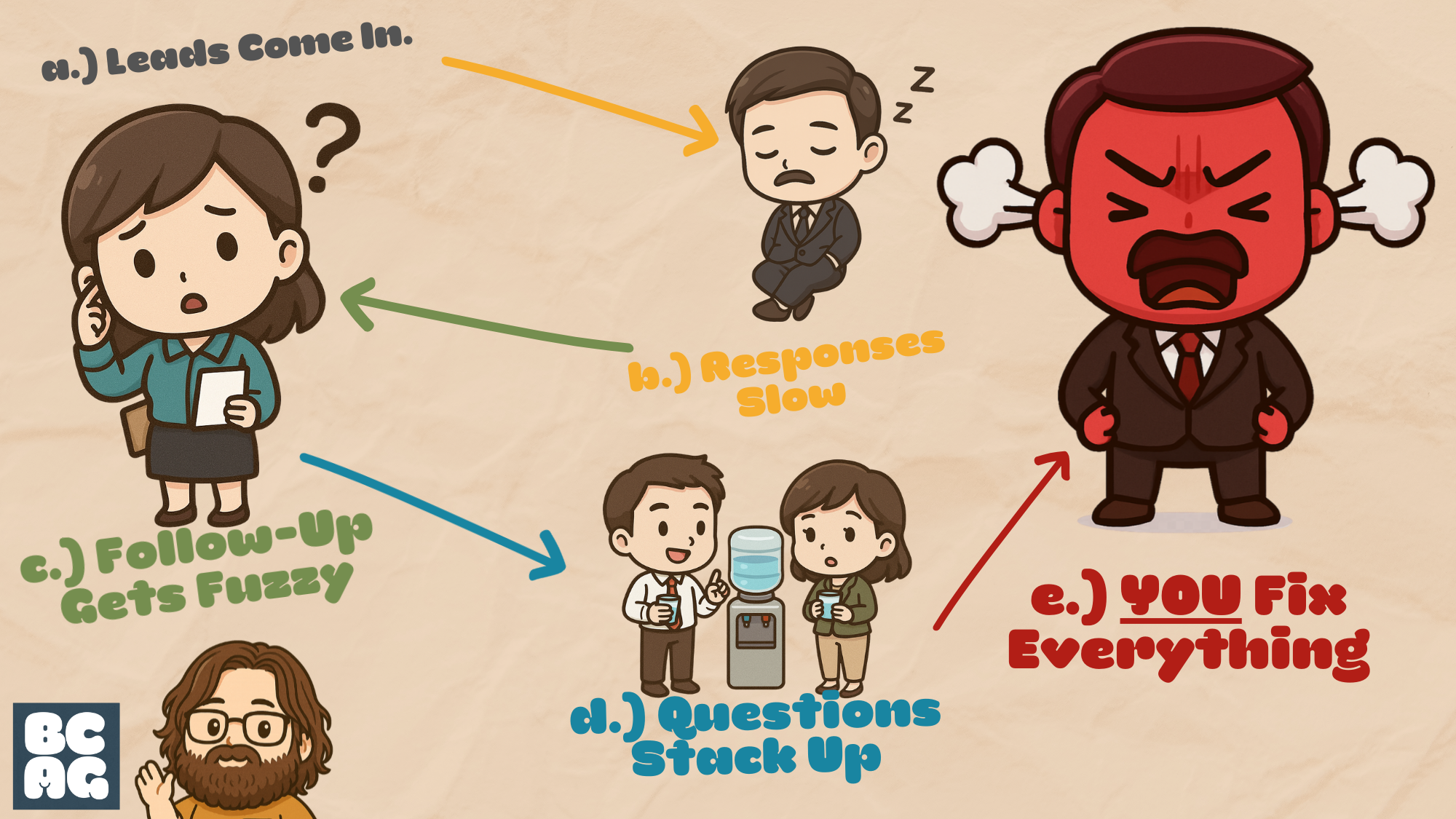
If this infographic doesn't speak to you like the Green Goblin mask from Spider-Man (2002), congrats! You are likely in a pretty good place. But that doesn't mean that there isn't still some room for improvement. In fact, I want you to do a little exercise to see what I mean.
Please take a few minutes to take the following quiz. It is important that you answer truthfully to receive the most accurate score. And, just a heads up, none of this data is tracked and doesn't require an email for your score. It's weird when people do that. I'm not weird.
Once you make it to the end, it will tell you how much of the system relies on you. This can give you a good idea of the pain points you are experiencing, so you can start digging deeper into how to change your systems.
Owner Involvement Test
One quick question at a time. Rate each statement from 1 (not true at all) to 5 (true even when you disappear).
So, How Do I Fix The Problem And ENSURE I'm NOT NEEDED 24/7?
Great question! However, there isn't a one-size-fits-all answer. But, certainly not by working harder and not by being more available. You fix the problem by separating presence from function.
Most owner-dependent businesses don't lack effort or intelligence. They often just lack clarity that exists outside the owner's own head. There is a simple way to look at this to understand a little clearer what is going on.
Decisions live in habits
Priorities live in instincts
Follow-ups live in memory
When the owner leaves, those things don't disappear because your employees don't care, the disappear because they were never anchored anywhere tangible.
The first step is to decide what must continue when you’re gone. Not everything. Just the things that keep the business upright. How leads are acknowledged. How next steps are defined. Who owns a conversation from start to finish. What happens when something pauses for too long. These don’t need to be complex. They need to be explicit.
Next, move visibility out of your inbox and into one place everyone can see. If progress only exists in private threads, side conversations, or “I talked to them earlier,” the system still lives in people, not in structure. When status is visible without you asking, momentum becomes self-maintaining instead of personality-driven.
Then remove decision bottlenecks by making expectations boringly clear. Most teams wait because they don’t want to get it wrong. When boundaries are clear movement replaces hesitation. Fewer things need you when fewer things are ambiguous.
Finally, test your absence on purpose. Leave for a day. Then two. Don’t hover. Don’t rescue. Notice where friction appears. Those moments aren’t failures, they’re instructions. Each one points directly to something that still depends on you.
You don’t fix this by disappearing forever. You fix it by building a business that doesn’t panic when you do.
When You’re Ready to Step Out Without Things Slipping, This Is the Part I Help Clean Up.
This is the work I focus on.
Not marketing in the abstract. Not tactics designed to create noise. I help untangle businesses that function well only when the owner is present and quietly stall when they are not. The kind where nothing is technically broken, but almost everything depends on one person stepping in at the right moment.
My role is not to replace you. It is to take what currently lives in your head, your instincts, your judgment calls, the way you naturally keep things moving, and translate that into systems the business can carry on its own. Clear ownership. Visible pipelines. Default next steps. Simple automation used to remove friction, not add complexity.
I work alongside you to identify where absence causes drag, then design structure around those exact pressure points. Not generic workflows. Not templated best practices. Infrastructure built around how your business actually operates when you are not there to catch everything.
The goal is not that you disappear. It is that your presence becomes a choice instead of a requirement. When you step away, things keep moving. When you return, you are not cleaning up. You are deciding where to focus next.
Take the FIRST STEP AND REACH OUT HERE!


